Filter
In the Explorer, you can filter and query data by specifying field name and field value.
Note
The main difference between filtering and searching is the presence of : (colon separator) in the input content. If present, it is considered a filter condition; if not, it is considered a search condition.
Operators
Different types of fields support different operators, as detailed below:
-
String field operators:
=,≠,match,not match,wildcard,not wildcard,exist,not exist,regexp,not regexp -
Numeric field operators:
=,≠,>,>=,<,<=,[xx TO xx],exist,not exist
| Operator | Description |
|---|---|
= |
Equal to, example: attribute:value |
≠ |
Not equal to, example: -attribute:value |
match |
Contains, example: attribute:~value |
not match |
Does not contain, example: -attribute:~value |
wildcard |
Contains, requires wildcard for fuzzy query, example: attribute:*value* |
not wildcard |
Does not contain, requires wildcard for reverse fuzzy query, example: -attribute:*value* |
exist |
Exist, filters data where the specified field exists, example: attribute:* |
not exist |
Not exist, filters data where the specified field does not exist, example: -attribute:* |
regexp |
Regular expression match, uses regex to match target string, example: attribute:/value.*/ |
not regexp |
Reverse regular expression match, uses target string to match regex, example: -attribute:/value.*/ |
> |
Greater than, example: attribute:>value |
>= |
Greater than or equal to, example: attribute:>=value |
< |
Less than, example: attribute:<value |
<= |
Less than or equal to, example: attribute:<=value |
[xx - xx] |
Range, example: attribute:[1 - 100] |
Wildcard
Supports * or ? wildcards, where:
-
*matches 0 or more arbitrary characters -
?matches 1 arbitrary character
Example:
Value: platform

# Using only suffix * matching, suitable when the prefix of a value string is fixed and exact, and the latter part changes dynamically
attribute:plat*    // * matches form

# Using only ? matching, suitable when only individual fixed-position characters are dynamically updated
attribute:plat?orm   // ? matches f

# Combined use of ? and *
attribute:pla?for*   // ? matches t, * matches m

# Combined use of *
attribute:plat*or*   // first * matches f, second * matches m
Special Characters
In the Explorer, some characters have special meanings, such as space used to separate multiple words. If the search content contains the following special characters, special handling is required: space, :, ", “, \, (, ), [, ], {, }.
For more details, refer to Special Character Escape Query.
Boolean Operators
Supports further combining and associating searches and filters in the form of AND/OR/NOT.
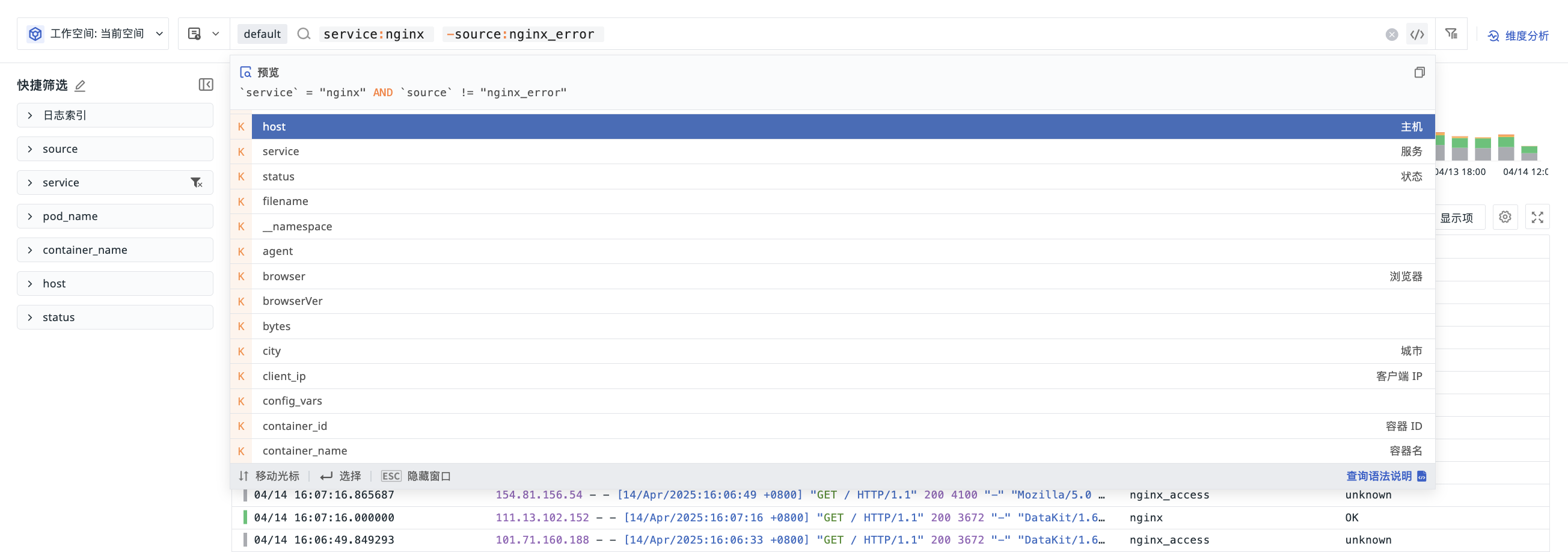
| Logical Relationship | Description |
Remarks |
|---|---|---|
| a AND b | Intersection of preceding and following query results | Search and filter conditions are connected by AND by default. AND can be replaced by space, i.e., a AND b = a b |
| a OR b | Union of preceding and following query results | Returned results must contain either keyword a or b. Example: a OR b:value |
| NOT c | Exclude current query result | NOT is mostly used in search syntax; for exclusion logic in filtering, use ≠ instead |
Grouping
Use parentheses () to increase the priority of data query conditions. If parentheses exist in the query, the query logic inside the parentheses is executed first. The priority within parentheses still follows the order NOT > AND > OR.
Manual Mode
Supports switching the search box to manual mode.
Applicable to all Explorers (except dashboards/custom Explorers). In this mode, you can add search and filter conditions via UI interaction, and freely switch between manual mode and UI mode without any changes to the content before switching, achieving real-time switching and restoration between UI and manual input.
Quick Filter
In the Explorer, you can edit the Quick Filter to add new filter fields. Two configuration methods are supported:
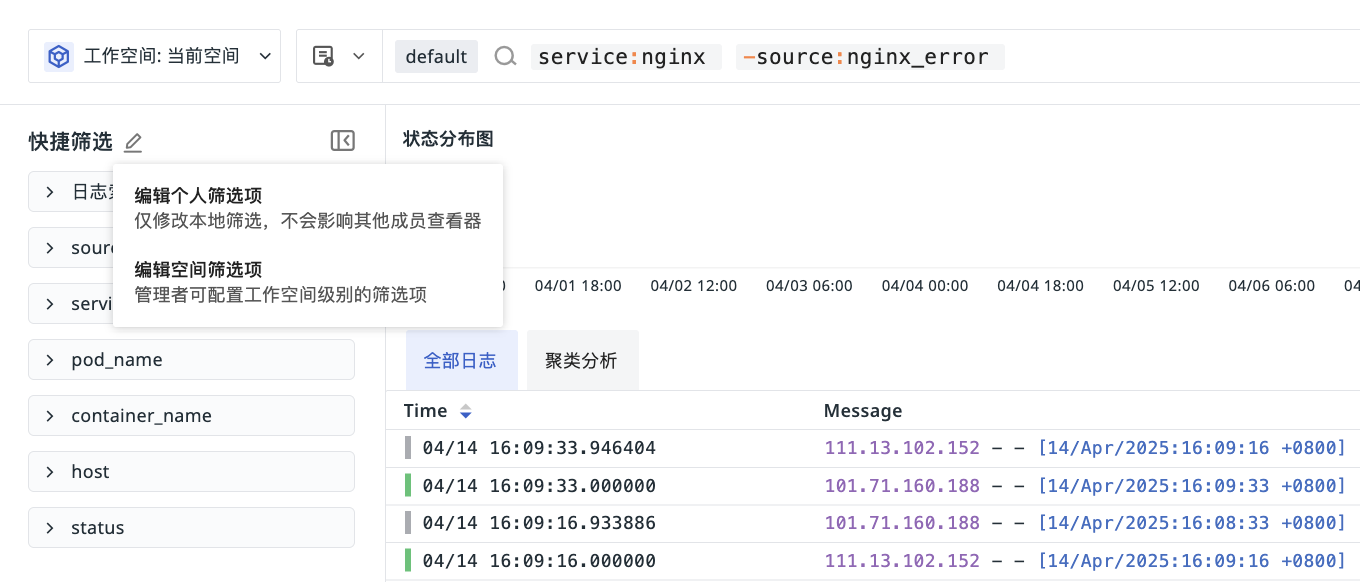
Configured by administrators or owners.
Visible to all members of the workspace, but regular members and standard members cannot edit, delete, or reposition them.
Note
After configuring filter fields here, the system automatically sets them as index fields. They can be reused directly in the search bar later.
All members can configure quick filter items based on the local browser.
Only visible to the current user; other members of the workspace cannot view them.
In the Quick Filter, preset fields are supported. Newly added fields default to the field type from field management. If the field does not exist in field management, it defaults to text format.
Upon entering the field editing interface, two parts of fields are displayed:
-
Filter Fields: Fields displayed in the Quick Filter
-
Optional Fields: All fields cached for the current data type
You can perform the following operations:
-
Search for fields; if no exact match is found in the query results, you can directly create and add it to "Filter Fields";
-
Edit field alias;
-
Drag to adjust field order;
-
Remove fields;
-
Set whether to display field alias.
Empty Value Filter
When the administrator enables the empty value filter in the global configuration, a "No Data" entry will appear at the bottom of each group in the Quick Filter, used to filter data where the field value is empty. Clicking it filters out data entries where the corresponding field has no value.
Options
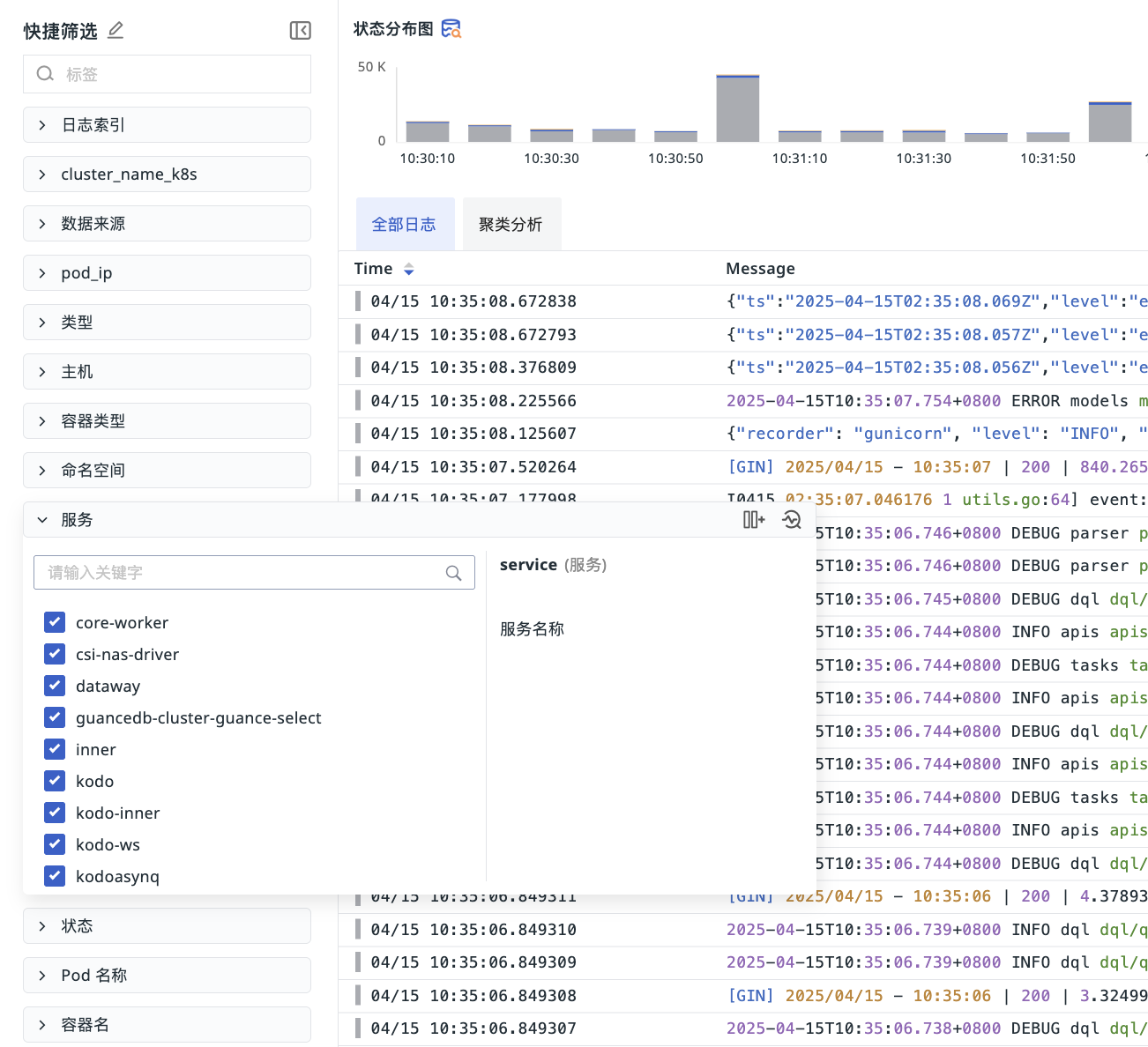
To optimize performance, quick filter items do not automatically refresh with changes in query conditions (time range, search filters, etc.). You need to manually expand the corresponding filter items to load or update their data.
Refresh Rules:
-
Initial Load: Upon entering the Explorer, all filter items are collapsed by default; some commonly used filter items (e.g.,
service,status, etc.) are expanded by default and load the current list data once. -
Manual Refresh: After adjusting the time range, search conditions, or filter conditions, the data of expanded filter items does not update automatically. To view the latest option list, temporarily collapse and then expand them again.
-
Independent Refresh: The global refresh button at the top of the page and the auto-refresh frequency settings (e.g., 5s, 30s) next to the time widget only affect data refresh in the Explorer's main list and do not impact the data state of options within the Quick Filter panel.
Clicking the row where the tag value is located selects only that value (only this value is selected). If multiple selections are needed, you can continue checking the checkboxes of other values. If a value is already selected singly, clicking its row again will deselect that value and cancel all filtering.
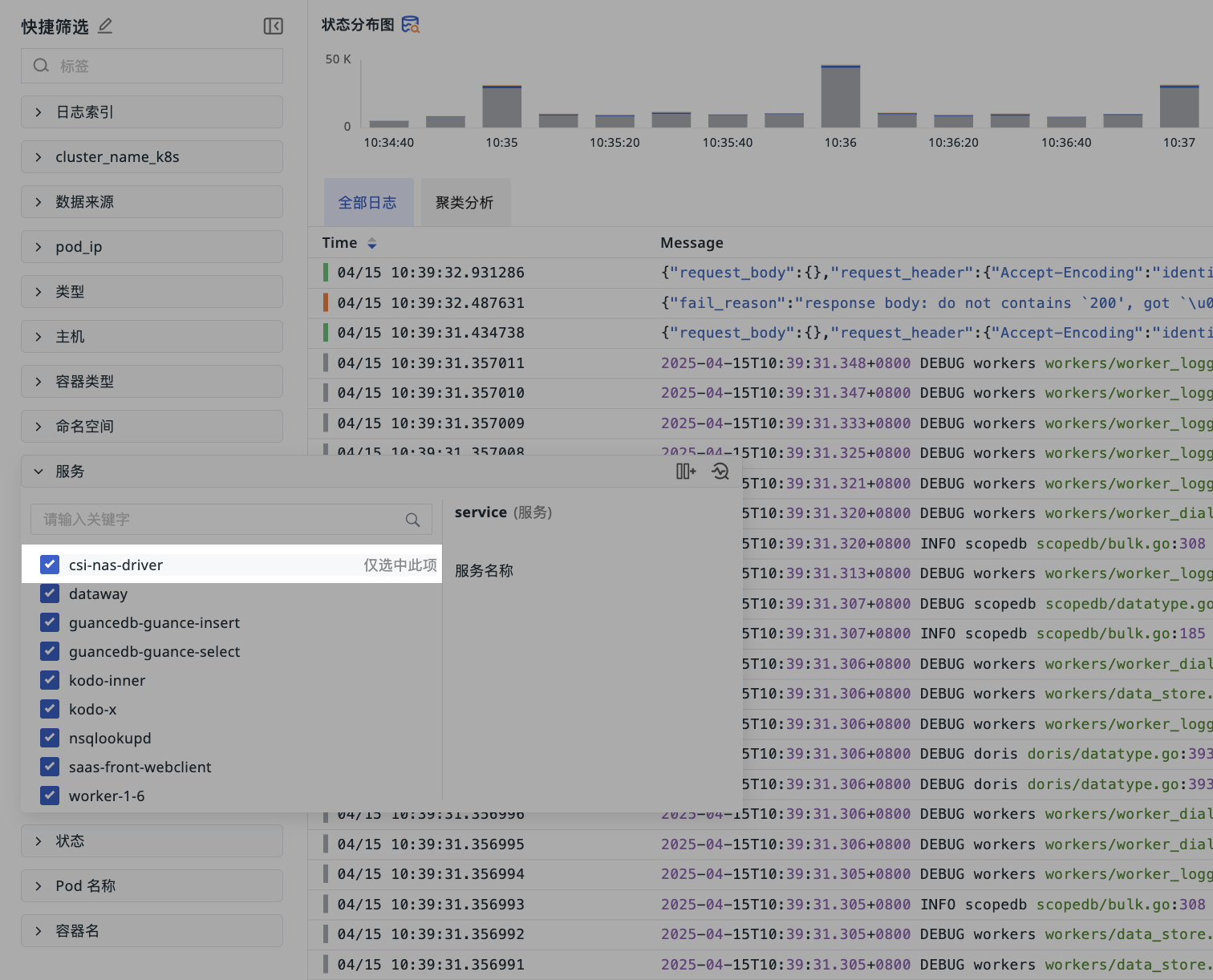
When there are more than 10 tag fields in the Quick Filter, you can perform fuzzy search by field name or display name.
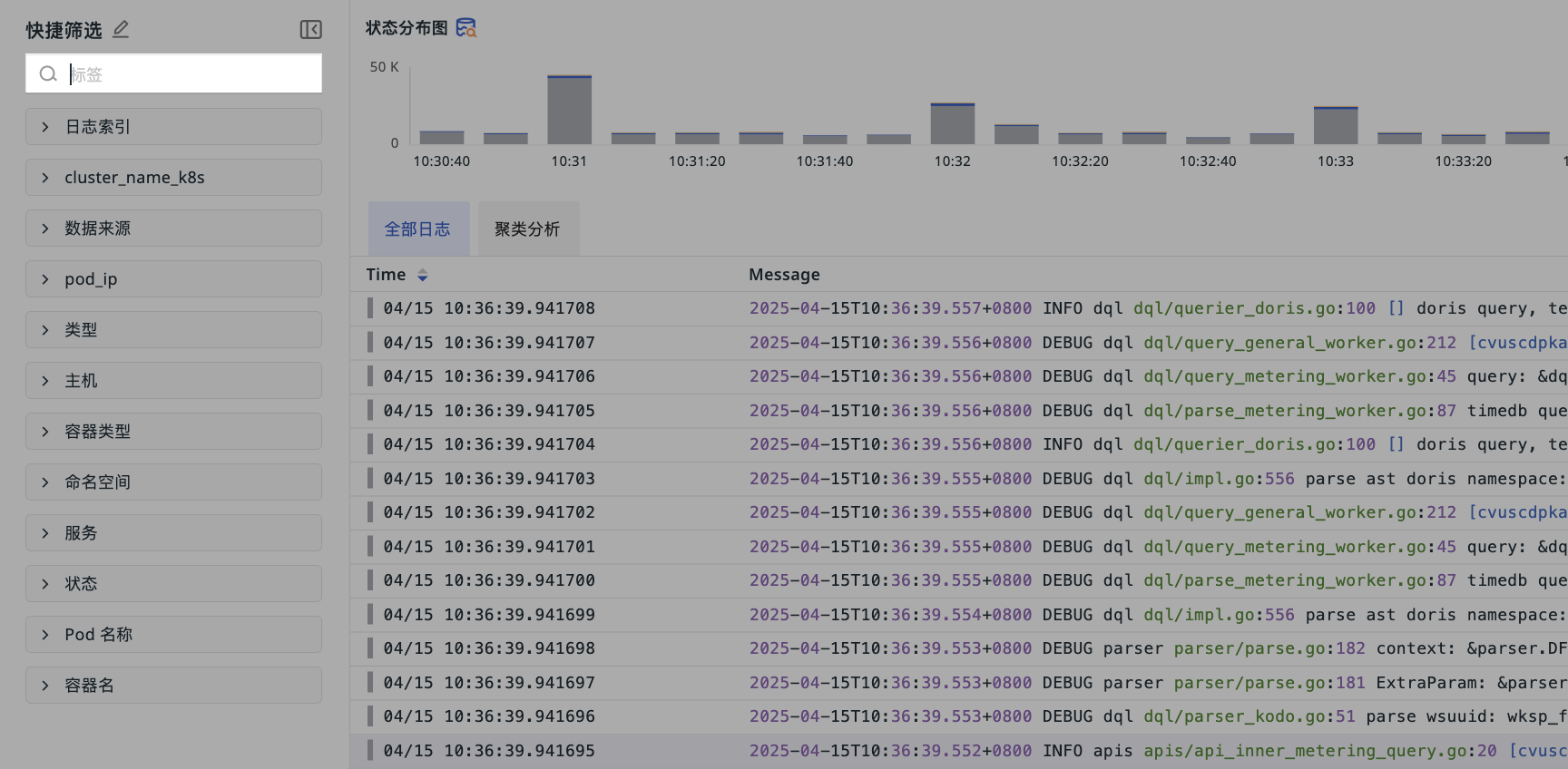
When a field attribute in the Quick Filter has more than 10 values, you can enter text for real-time search. Additionally, you can filter by clicking the fuzzy match or reverse fuzzy match buttons.
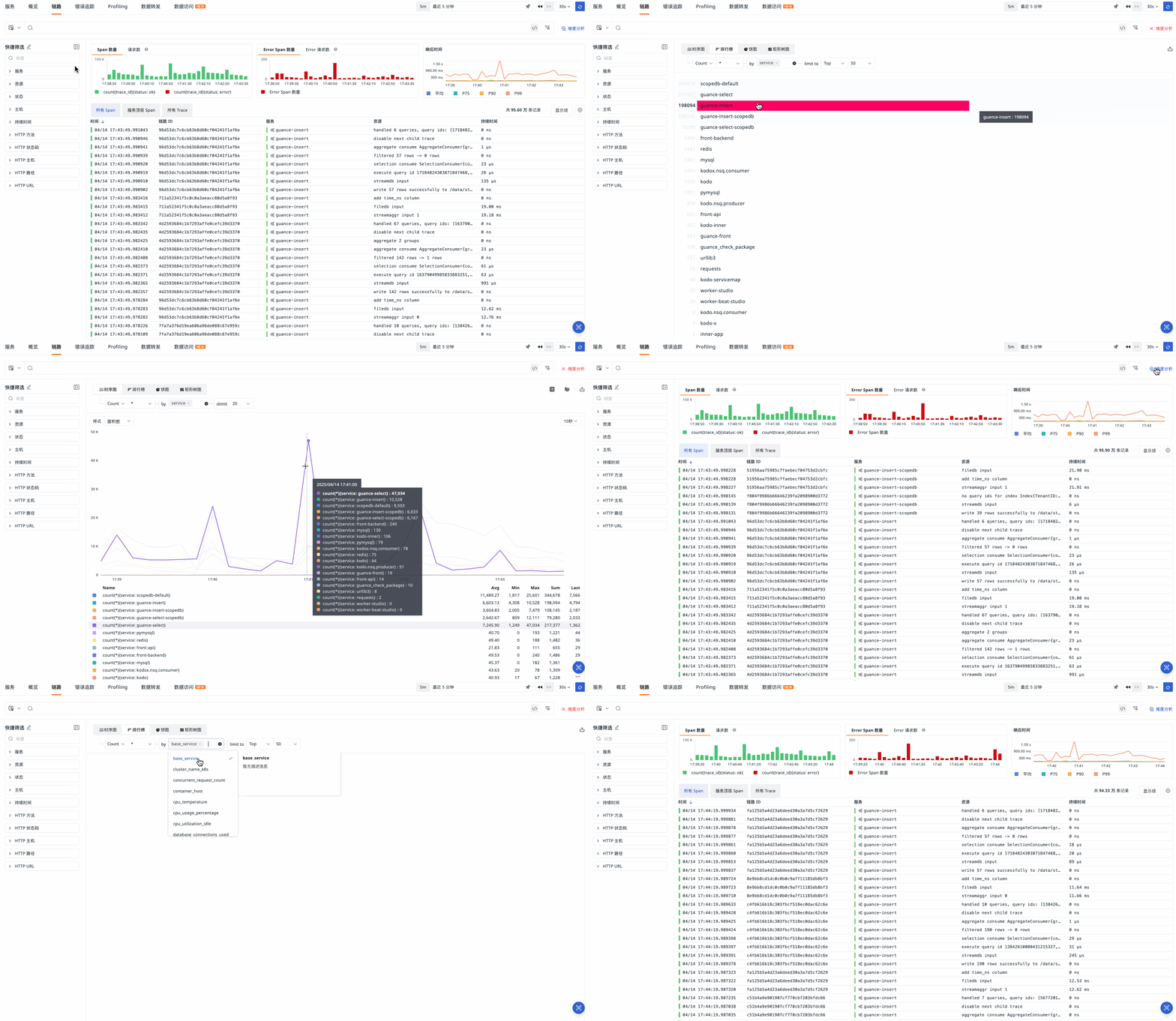
Clicking switches the current Explorer to Analysis Mode, with this field automatically substituted into the "Analysis Dimensions" for querying.
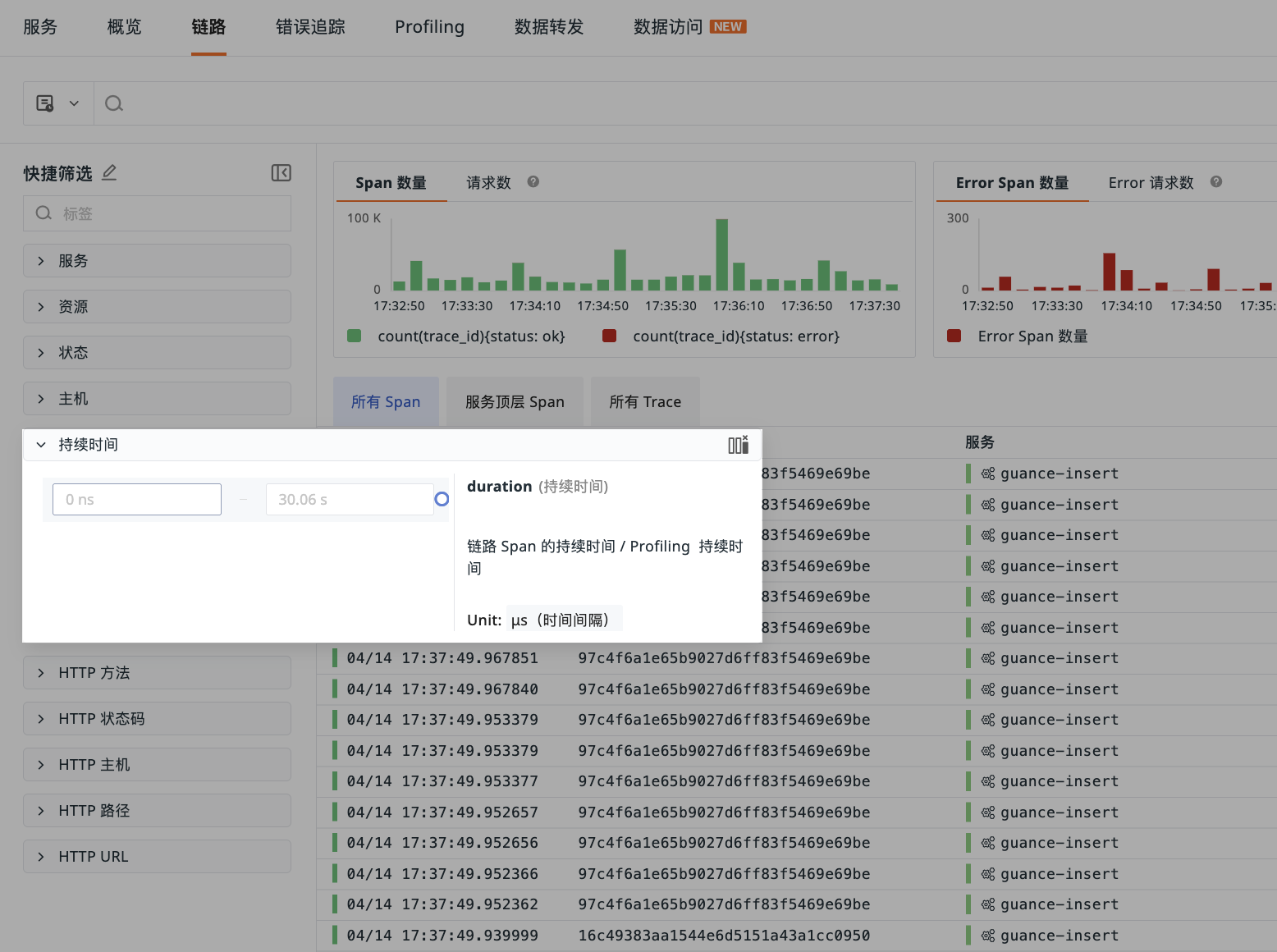
If the Quick Filter in the Explorer contains the duration field, you can manually adjust the maximum and minimum values for query analysis.
- By default, the minimum and maximum values of the progress bar are the minimum and maximum durations in the trace data list, respectively.
- If the input format is incorrect, the input box turns red, and no search is performed. The correct input format is pure "numbers", or "numbers + ns/μs/ms/s/min".
- If no unit is entered for the search, the system defaults to adding "s" after the input number for filtering.
- If a unit is manually entered, the search is performed directly according to the input unit.
Filter History
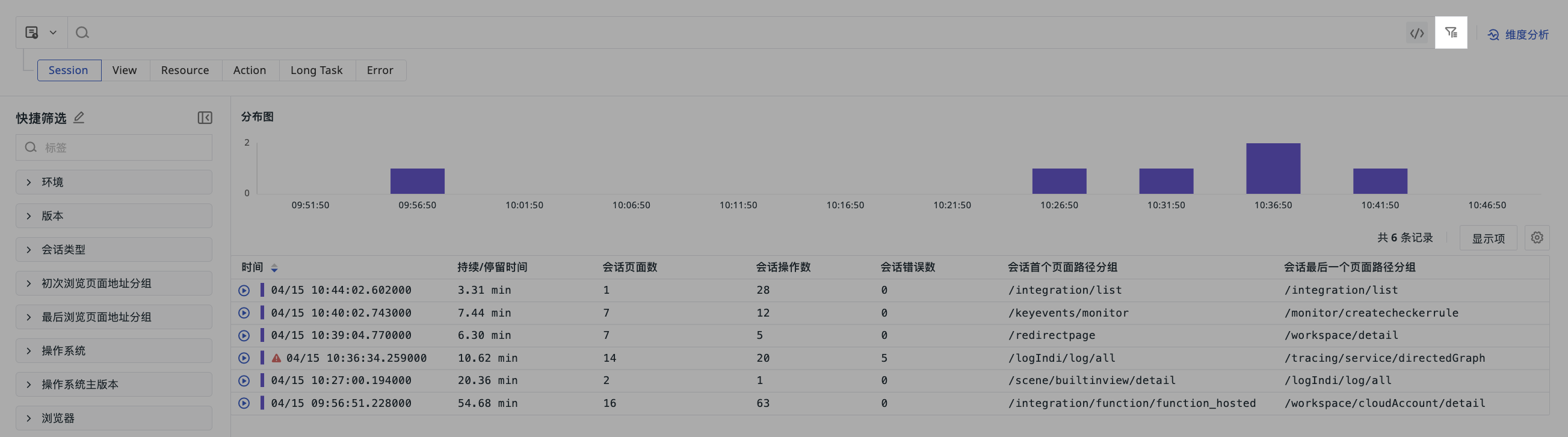
You can view filter and search history and apply it to different Explorers within the current workspace. Click the icon on the right side of the search bar above the Explorer, or use the shortcut (Mac OS: shift+cmd+k / Windows: shift+ctrl+k) to quickly open the filter history.
Note
Filter history is only supported for viewing the current user's filter and search conditions in the local browser.
Options
In the Explorer's filter history, up to 100 filter conditions can be viewed.
-
Pin to Filter: Click the pin to filter button on the right to pin the filter condition to the top;
-
Add to Filter: Directly click a filter condition to add it to the Explorer for filtering; multiple selections are supported;
-
Apply Filter History Across Different Explorers: For example, after browsing the filter history of
-source:defaultin Log > Explorer, you can directly use this filter condition in other Explorers like Trace.